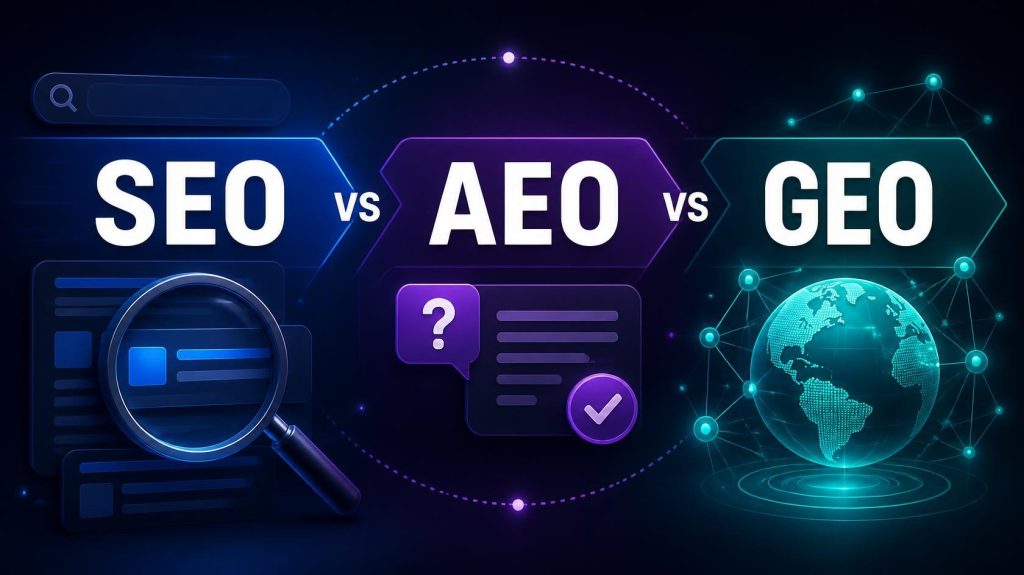
You know SEO. Here’s AEO and GEO.
You already know SEO. AEO & GEO acronyms are the same job with a new surface: showing up when someone gets an answer instead of a list of links.
The habit changed. The website work did not.
Plenty of people still Google a phrase and click a link. That is still SEO, and it still matters.
A growing share never get that far. They ask ChatGPT. They read the summary box on Google. They type a full question into Perplexity (or whatever LLM engine they use) and wait for a written answer with a few names underneath.
In those moments, there is no page two. A handful of sources get cited. Everyone else disappears.
SEO, AEO, and GEO – the short version
The industry argues about the labels. You do not need the argument. You need this:
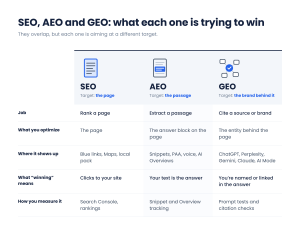
- SEO ranks a page in a list of links.
- AEO (answer engine optimization) makes a passage easy to lift as the direct answer – snippets, voice, Google AI Overviews.
- GEO (generative engine optimization) is about being named or cited when a tool writes its own answer – ChatGPT, Perplexity, Gemini, Claude, Google AI Mode.
Same site. Three jobs. Not three budgets.
GEO has a research paper behind the name. AEO is an industry nickname. Operationally they overlap so much that treating them as separate retainers is usually just a sales move.
SEO vs AEO vs GEO – what each one actually does
What Google says (read this first)
For Google’s own AI features, there is no secret playbook. Google’s guide to generative AI features in Search is the source of record.
The short version:
- The page has to already qualify for regular Search – indexed, crawlable, allowed to show a snippet.
- Original, useful content beats generic “tips” posts a tool could have written without you.
- You do not need an llms.txt file, special AI markup, or chopped-up “chunks” for Google. Search does not use them.
If you only click one link from this post, click that one. Google also covers eligibility here: AI features and your website.
What to do if you run a small business or nonprofit
Skip the new acronym package. Do these on the site you already have:
- Write down 20 questions customers already ask you. Run them through Google, ChatGPT, and Perplexity. Note who gets named.
- On the pages that should answer those questions, put the answer in the first sentence under a question-style heading.
- Make the business easy to identify: same name, address, and phone everywhere, a plain-English About page, a complete Google Business Profile.
- Publish a few specifics only you could write – prices in your market, timelines, local process – not another recycled listicle.
- Once a month, rerun the same questions and see if you showed up.
Local, specific questions are the opening. You will not beat a national publisher for “what is marketing.” You can be the source for “what should a nonprofit homepage do” or “who builds small-business websites in York, PA.”
If you want to go deeper
These are the sources worth your time. They disagree on labels. They agree on the work.
- Google: Optimizing for generative AI features – official. Start here.
- Google: AI features and your website – what makes a page eligible for AI Overviews and AI Mode.
- GEO: Generative Engine Optimization (Aggarwal et al., 2023/2024) – the paper that named GEO.
- HubSpot: AEO vs. GEO explained – a clear industry write-up if you want a second plain-English take.
Want a second set of eyes?
Most of this is unglamorous: crawl access, clearer pages, and answers that match how people actually ask.
We work with small businesses and nonprofits on the site and content work behind that. If you want a concrete plan for your pages, the discovery call is free and pressure-free.
Start here: dxmedia.io. Bring the questions your customers already ask. That is enough to begin.